You notice an IPSC target with an oddly shaped hole while scoring and you notice a wall hit that lines up with that odd hole. The competitor only fired two shots at the target and both holes are in the C-zone. Best 2 hits score. The wall and no-shoot were inspected and restored after the previous competitor. As the RO, how do you score this target?
This Question of the Month was based on a stage at the Race Gun Nationals match in Hurricane, Utah in October 2025. The match included a stage that had cardboard no-shoots hung on the edges of a few walls. We typically recommend against doing this (see this post), but in rare cases it may be the simplest solution to either hide a target or to protect walls. That was the case with the Nationals stage: the match directors and setup crew tried as many ways as they could think of to hide the targets while maintaining the integrity of the stage design but in the end the addition of a few no-shoots on wall edges was found to be an expedient way to solve the setup problem. It’s not ideal and is best to avoid, but with careful scoring and close attention it is a workable solution.
For the most part, scoring the stage was straightforward. We had an excellent crew on the stage, and they all made a point of inspecting each of the no-shoots as the targets were scored and the stage reset. In general, the use of free-standing or wall-hung no-shoots may lead to penalties getting missed during scoring or such a penalty may not get noticed until several shooters later. The stage crew at Nationals did a great job of watching the no-shoots (one of the benefits of a large, well-staffed match with dedicated stage range officers).
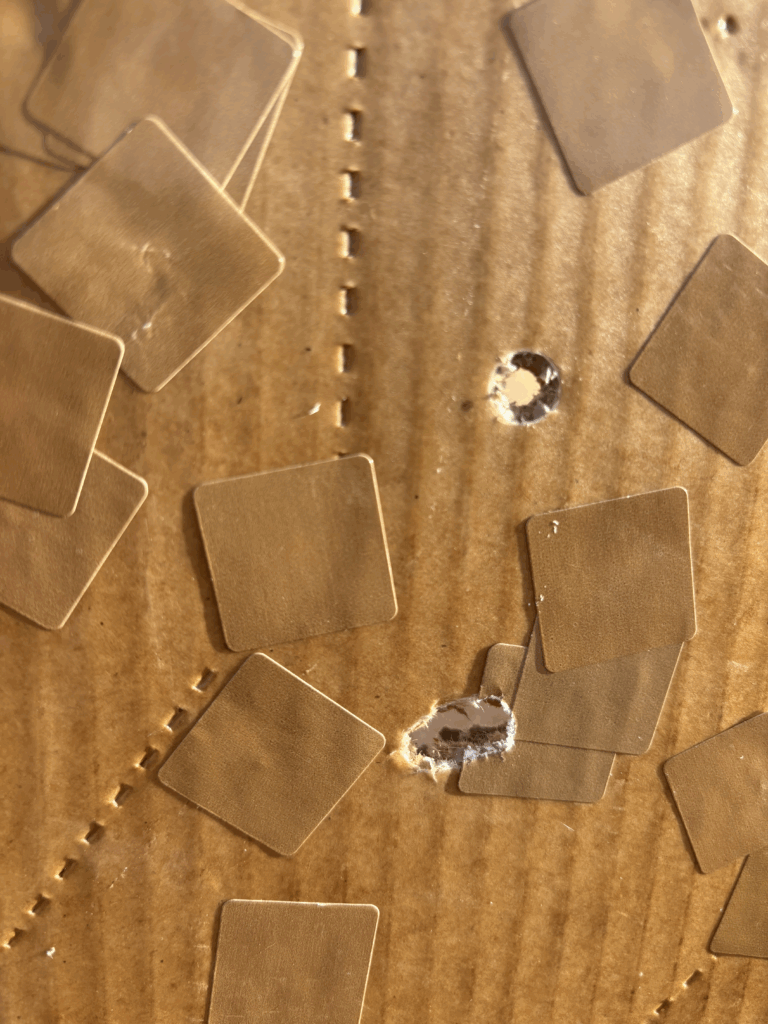
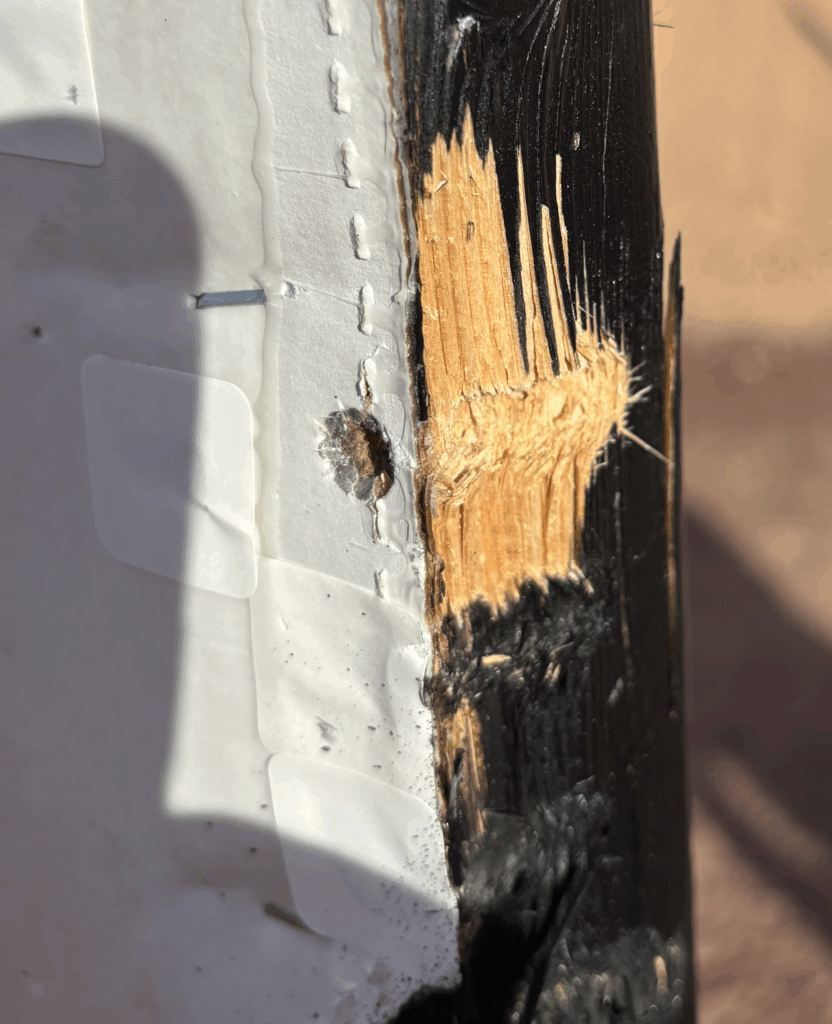
We did have one or two interesting scoring calls resulting from the placement of the no-shoots, and that’s the main topic of the QOTM and this article. The first photo below shows an obvious penalty hit on the no-shoot, and the second photo shows the two hits in evidence on the scoring target behind.
The hit on the no-shoot clearly touches the scoring area of the no-shoot and so resulted in a penalty. The question is, what is call on the scoring target behind, based on the photos shown? Is the appropriate call 2C and 1NS or is it 1C, 1M, and 1NS?
Rule 9.1.5.3 states that a bullet striking partially within the scoring area of a target (or no-shoot, in this case) will count for score if it strikes another target downrange. Since the bullet passed through the non-scoring border, it counts for score downrange, right?
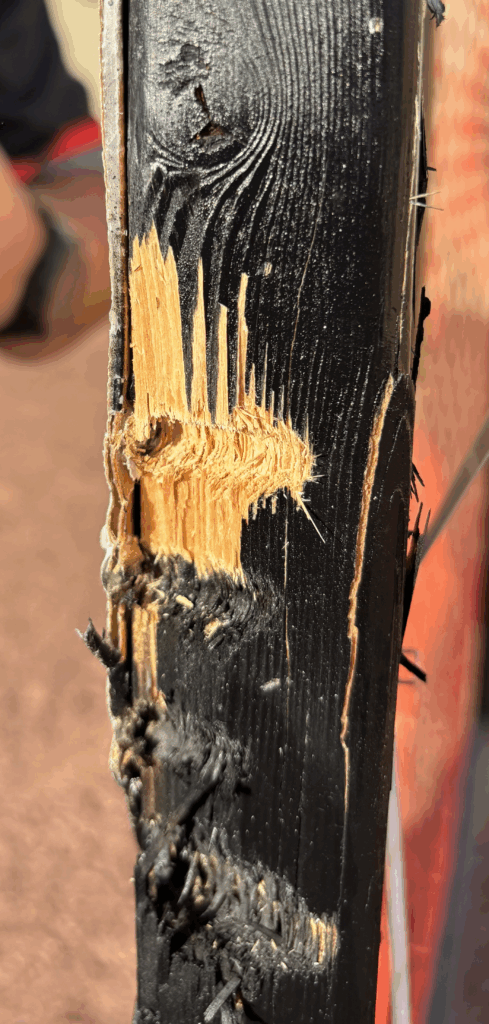
Maybe, but it’s not that easy. Remember also that walls and other props are considered to be hard cover unless specified otherwise in the Written Stage Briefing (2.2.3.3). Looking closer at the first photo (lower hole) and at the third photo, taken from behind the wall and no-shoot in question, it is evident that the bullet passed wholly through the hard cover (i.e. the wall) and so will not count for score downrange. On this target, the appropriate call was 1C, 1M, and 1NS. The lower hole on the target is obviously mis-shaped, which usually indicates the bullet was tumbling because it had passed through a hard object before the target. And on the wall, there is evidence that part of the wood flew off (it was painted black before the hit) and you can see it was a full-diameter hit before the wood fell apart.
As competitors and range officials, we tend to focus on the targets we’re scoring and might miss a free-standing no-shoot. In this case, we try to be diligent about inspecting the no-shoots for penalties, and focusing on the perforation for scoring, but we also need to be sure to not lose sight of the bigger picture.
The survey results indicate that nearly all of the respondents correctly scored the no-shoot, but many did not catch the miss due to the hard cover wall. Hopefully the question and this article have been helpful in explaining the complexity of this unusual scoring situation.
So, what is the upshot? I had a few takeaways after working this stage for three days. It is still best practice to avoid using free-standing or wall-hung no-shoots if possible. If the use of them is unavoidable, make sure to incorporate inspection of them into your target scoring pattern. For wall-hung no-shoots, pay attention to their placement relative to the wall behind them. If the no-shoot is hung with the perforation lined up with the wall edge, or possibly slightly beyond the wall edge, it may make scoring a little easier in that a hit partially in the no-shoot would also be only partially inside the hard cover of the wall.
Remember to cast your vote in the current Question of the Month!