Short, medium, and long courses cannot require more than 8 scoring hits from any single location or view. Which means if you help build or design stages you need to understand the definitions of a location and view in order to make sure the stages are legal.
First, let’s look at the definition of a location from Appendix A3: A physical space within the boundaries of a course of fire. For the purposes of this rule, a competitor will not be considered to have changed location until both feet have moved to a new physical position.
The definition of a view from Appendix A3 is: A range of sight or vision specific to an array of targets. In order to constitute a new “view” under this rule, the range of sight of an array of targets must be broken by a vision barrier of some sort, such that a different array of targets is seen in the new view.
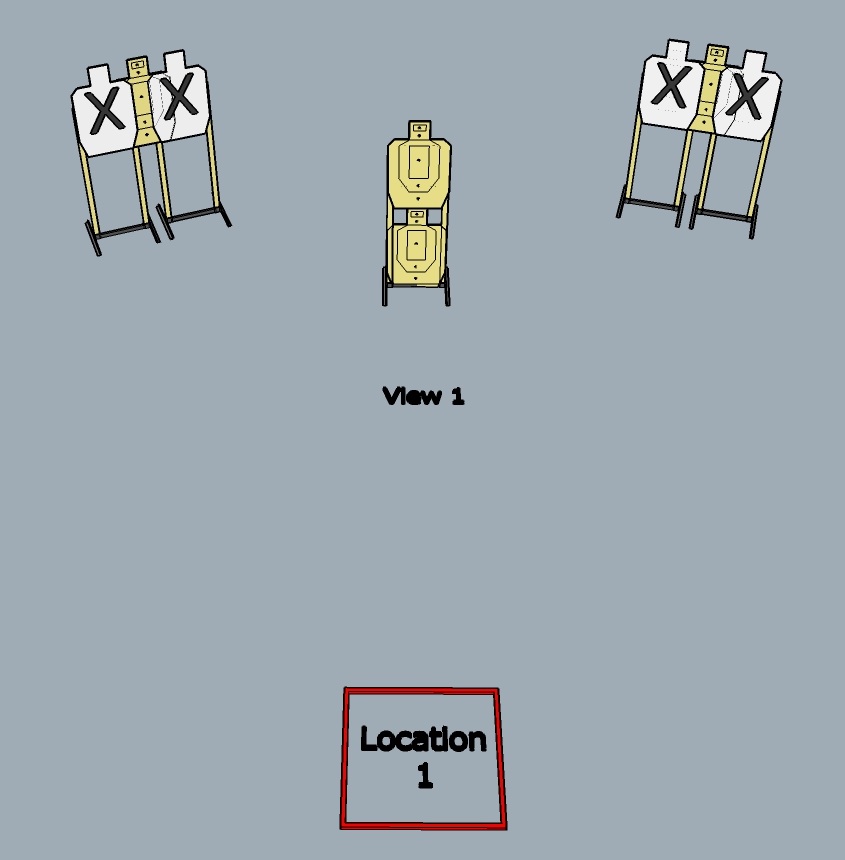
Think of a position as a spot where a competitor stops to engage targets and a view are the targets seen from that position. Here is a very simple example of a single position with one view. We have a single location with a view of 4 scoring targets. This would be a legal short course because it doesn’t require more than 8 scoring hits from a single location or view (best 2 hits per target will score). If the best 3 hits per target were scored, then this stage would not be legal because it would require 12 hits from a single location and view. But could we make this stage legal? Yes!
Let’s go with the 3 best hits score per target and fix the stage design by creating multiple views. Doesn’t take much, just need to add a wall.
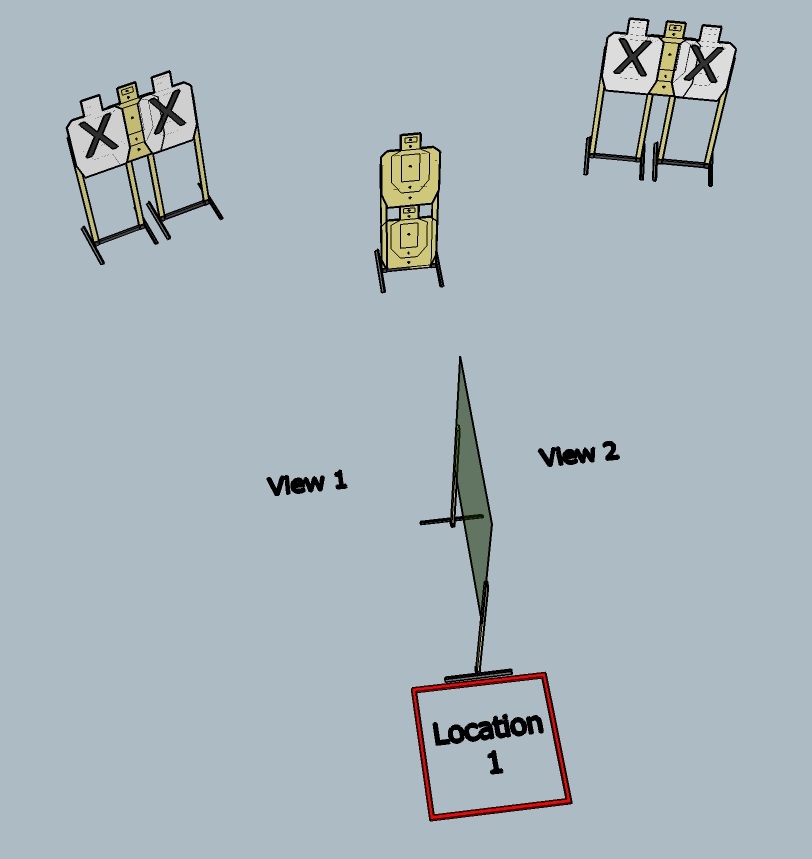
It isn’t the most exciting stage, but it is legal. The stacked targets in the center are available from both view 1 and view 2. Yes, a competitor can choose to shoot 3 targets (9 shots) from one side of the wall but is not required to take all 9 shots from one view because those center targets are also available in the other view. It’s called freestyle and this allows for all the divisions to come up with suitable stage plans for their magazine capacity. This is a boring stage design. But it is a good stage to explain the concept of location and view.
But why do we have the rule about no more than 8 required shots per location or view? Mostly to encourage movement in our stages and not allow a competitor to engage all the targets from a single position (that’s boring). Our sport is all about moving through a course of fire. And our sport also is about doing reloads when the stage is long enough. Ideally competitors do reloads while moving between locations and 8 shots is a number that encourages stage designers to add breaks to do reloads, especially for the low capacity divisions (e.g. Single Stack, Revolver, Limited-10). It also means a 12 round short course will have at least 2 views/locations and a 32 round long course will have at least 4 views/locations.
Yes, I know the number of lo-cap competitors is dwindling, but reloading multiple times during a stage is a good skill and designing legal stages that accommodate all divisions is also a good skill. We will discuss stage design in relation to location and view a bit more next week.