Cardboard sometimes creates artifacts around bullet holes due to its corrugated construction. But do those radial tears count for score? Let’s examine this deeper in this Question of the Month.
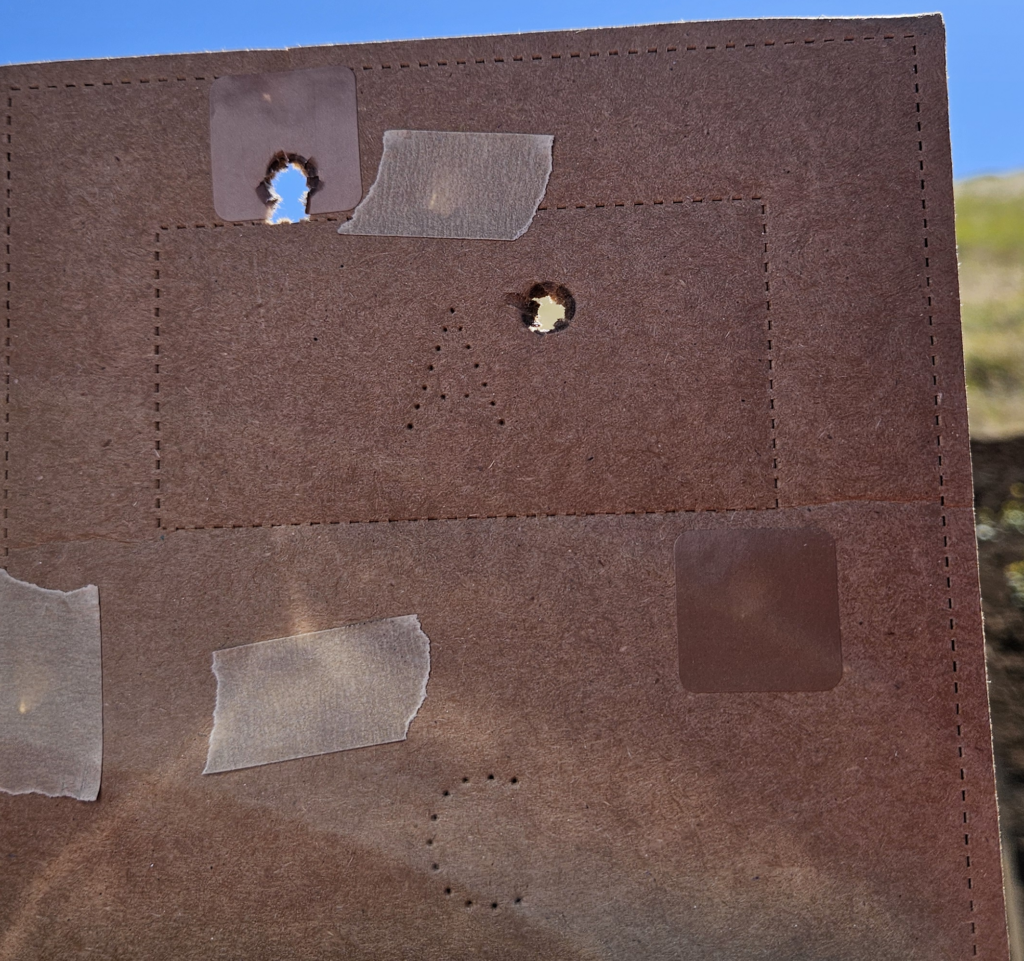
What is the score of this target? (Best 2 score)
Okay, this Question of the Month was obvious to most members, but is often something that new competitors don’t understand. The big misunderstanding is because newbies hear ROs say that the hit must touch the perf to score, but then say that doesn’t apply in the case of the upper hole in this picture. Let’s discuss why that is.
First, let’s look at the rules that apply.
9.5.2 If the bullet diameter of a hit on a scoring target touches the scoring line between two scoring areas, or the line between the non-scoring border and a scoring area, or if it crosses multiple scoring areas, it will be scored the higher value.
This rule is why we give Range Officials overlays to assist with scoring (See this post for more on overlays). Notice the rule says ‘bullet diameter’, not the hole, needs to touch the scoring line or non-scoring border line (also called perforations). Often the hole we see is smaller than the actual bullet diameter which is why we overlay holes that are close to the perforations to get an accurate score.
9.5.4 Radial tears will not count for score or penalty.
This rule is the “best” rule for this question. When you look at the upper hit on that target, the hole has a radial tear on the bottom edge that extends to the A-zone perforation. Some folks think that means that the hit touches the perforation between the C and A-zones and means it should score as an Alpha. However, radial tears don’t count and when we overlay that hole, the bullet diameter does not touch the perforation either.
This means the correct answer is that this target is scored as Alpha-Charlie. Which was the top answer! For those of you who got it correct, please help educate new members when they are confused and ask questions.
Remember to cast your vote for the current Question of the Month!